Addendum: A brave and bold move!: From the NWF website: "...Therefore, NWF and Scotts will work together to end the partnership in a friendly and mutually beneficial way."
I was quite surprised to read a press release from National Wildlife Federation (NWF) announcing their partnership with ScottsMiracle-Gro. NWF is a popular national nonprofit. Many people support NWF particularly through their "Certified Wildlife Habitat™" Program to get the sign indicating such.
I have major concerns about an alliance that pairs up an organization that advocates protection of wildlife with a company that makes chemicals, some of which are designed to kill food sources of wildlife. And, since last I checked, runoff from fertilizers was one of the major sources of water quality issues in Florida. Scotts' products include fertilizers.
NWF has its reasons for this odd pairing as described in an interview with Carole Sevilla Brown, none of which has sold me on the idea that this is a good idea and won’t have an overall adverse impact on the environment. I personally feel that the benefit by increasing the number of people reached will be negated by the brand association.
Clicking on the link from the NWF press release page to the Scotts' Website brought up a clickable link which read as follows:
"Have a Lawn, Garden or Home Pest Control Problem".
I don't understand how this fits in with wildlife preservation. I advocate for insects since they are the baby food for bird fledglings. Baby birds, incidentally, can’t eat the birdseed being touted in the part of the NWF/Scotts alliance called "Save the Songbirds". They need bugs, some of which are not to the liking of some gardeners who buy chemicals to eliminate them. But, given the chance at balance by eliminating this pesticide use, insects can be controlled naturally. My garden is proof of that.
While NWF doesn’t support all of Scotts products, I can’t in good conscience support or recommend an organization that partners with a corporation that makes any products which kill wildlife food sources. I don't believe that people will not associate all Scott products with being acceptable to use. It's that brand association thing.
So, I am advocating that if people really want to protect wildlife in an environmentally sensitive way that rather than contributing to a large national charity, that they look local. In Florida, the Florida Native Plant Society (FPNS) is a local nonprofit organization. "The purpose of the Florida Native Plant Society is to promote the preservation, conservation, and restoration of the native plants and native plant communities of Florida." This mission, in protecting native habitat, in turn protects wildlife.
When the beauty of your garden and all the butterflies and birds flutter around, you won’t need a sign to let people know you have a habitat which meets the criteria of certification by NWF. They’ll know just by looking at it.
So, please keep your donation dollars local. It will also serve to help the community, as local dollars are used for local purposes so you can see the benefit of your donation firsthand. I’d rather see butterflies landing on native plants than signs stuck in the ground, any day of the week.
Showing posts with label wildlife. Show all posts
Showing posts with label wildlife. Show all posts
Wednesday, January 25, 2012


Thursday, August 25, 2011
The Sulphur Butterfly Emerged Already!
If you read the blog over at Beautiful Wildlife Garden, you'll know in a recent article of mine I wrote about a caterpillar changing color based on the plant it was eating.
The cloudless sulphur caterpillar quickly turned into a beautiful butterfly. Here's a short, "From Caterpillar to Freedom", video slideshow:
It took considerably less time than I anticipated. Only 6 days from chrysalis to emerge. SPEEDY!
The cloudless sulphur caterpillar quickly turned into a beautiful butterfly. Here's a short, "From Caterpillar to Freedom", video slideshow:
It took considerably less time than I anticipated. Only 6 days from chrysalis to emerge. SPEEDY!
Saturday, April 16, 2011
Will this be the Year? Purple Martins

 I heard the wonderful music and looked up at the purple martin apartment that I put up a couple of years ago. There was a pair, checking the back and the front. In and out the compartments they went. They teased me last year with their arrival and got my hopes up that I would become a landlord, but it never happened.
The house is situated so they have a clear flight line and it overlooks the pond. There are plenty of "eats", so I think it is the perfect housing arrangement and I hope this year they do too! Although, I'm guessing they will eat my dragonflies, which saddens me, in a way. Stay tuned!
Wednesday, January 26, 2011
Bird in the Night

I recently had a visit from a Killdeer, my first encounter of this plover-type bird. I heard it before I saw it, and I haven't seen it since, but I know it still is around.
 At night I let the dogs out for their last trip to potty around 10:00 p.m. There is a street light a couple of lots over which is more than enough light for this "Dark Sky" loving individual, but pretty much it is dark in my rural yard…VERY dark. The Irish Setter and Yellow Labrador are free to run on their own at this hour, but my English Setter, Tanner, needs to be on a leash, as he would never come back inside given the choice of searching out wildlife in the garden or coming back inside to sleep. He's a nature lover, as well.
Stomped down grasses with a "hole" at the fenceline from my neighbor's natural area is evidence that I have marsh rabbits that visit the pond at night. The sound of doves taking flight as we walk along the driveway also whets his appetite to stay outdoors. But, nothing has captured his interest as the killdeer (pictured top during the day). The alarm sound of this bird has created a monster in my English boy. At first he merely perked up his ears and got in a "set" position. Now he wakes me faithfully at 4:00 a.m. with pleas of needing to go out. He really doesn't need to go…he just wants to flush out and hear this bird that is using our meadow grasses as night cover. Although sleep deprived, I find it amusing.
I find it more interesting that the bird chooses to stay in the area that the dogs have access to 24/7. Just yards away, on the backyard side of a fence, is my bird "promotion" area which the dogs only have access to when I am with them. Perhaps the killdeer is lying in wait to be amused as well.
Sunday, January 9, 2011
Butterfly of Winter
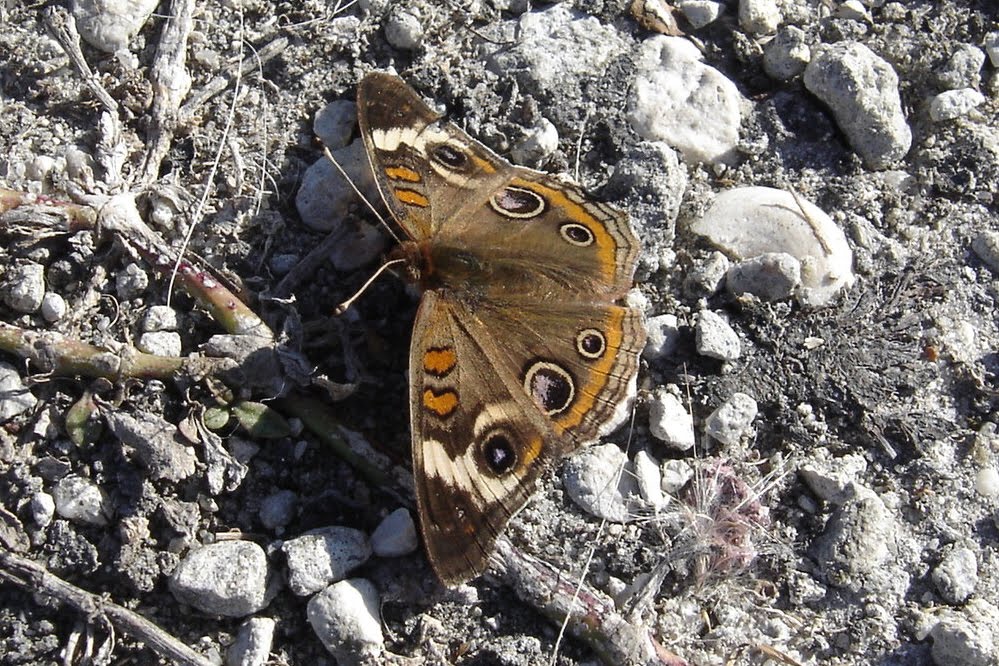
I saw another Common Buckeye today when not much else of the insect variety was showing itself in the cooler temperatures. Somehow "common" doesn't describe them at all...they are quite regal-looking with their numerous eyes on colorful wings.
The photo here is one from after the first freeze in December as I was not quick enough to capture today's brave soul with the camera. You can click the picture to see it full size.
Junonia coenia is the scientific name for this species which uses several different larval hosts in Florida which in my garden include: fogfruit (Phyla nodiflora); toadflax (Linaria spp.); plantain (Plantago spp.) twinflower (Dyschoriste spp.) and bluehearts (Buchnera americana). Based on this long list (there are other hosts too), the caterpillars aren't particularly fussy.
They are a little on the shy side...darting off if you cast a shadow too closely, but every now and again they will be so enthralled in a flower or hanging out in the gravel driveway that you'll get a good photo. And they sure do help brighten a winter day.
Be sure to visit over at beautifulwildlifegarden.com for great ideas on attracting wildlife to your own garden.
Monday, October 4, 2010
A new venture!
I've been invited by beautifulwildlifegarden.com to be a voice from Florida with a weekly blog post on Fridays on providing for wildlife. I'm an eternal procrastinator as you can see by the lack of recent posts here. Given a deadline I meet the challenge and maybe it will inspire me to keep up a little more often here as well. It is a grand group of bloggers and tweeters who all care about wildlife and I'm honored to be a part. Click on their logo on the left side of my page to go read the fabulous information on gardening for wildlife that has already been posted. I've picked up great tips from these environmentally conscious writers and I'm sure you'll learn a thing or two from every post no matter what area of the country you live.
Tuesday, February 23, 2010
Twigs2Fledge™

I got involved in monitoring my bluebirds when I first moved here in 2006 and saw an article in the local paper by one of our extension agent experts. She wanted people to report where we saw bluebirds. I had them in the yard and was surprised that they were a rare occurrence. I reported in that they were always flitting around my yard and Eleanor Foeste (the extension agent) inquired if there were nesting boxes in the area. I never heard of a nesting box so I looked it up on the Internet, read up quite a bit on how bluebirds are dwindling in numbers due to habitat loss and decided that would be the perfect gift for Santa to bring me for Christmas 2006.
I put up my box in February/March 2007 and was surprised to have residents almost immediately. It is of cedar construction and was purchased at a local big box store. I had read that it can sometimes take years for the bluebirds to find and be comfortable enough to use a nesting box. I guess because I maintain a good deal of my yard as a natural landscape which is in a semi-remote rural location, the birds were happy to move in quickly. That first year I had two broods. In 2008 I had four broods (the last a mere two babies) and in 2009 I had three broods. I follow the tips I found on http://www.sialis.org/ and I do check the babies for parasites and last year provided meal worms to help momma when she had a rather large brood (6). It is a well written and informative site and I even asked a question one time and received immediate (less than a day) answer when I thought I had an early loss (apparently they were older than I had initially counted and fledged on time--I need to go back and relearn arithmetic).
Bluebirds are fascinating and fun to watch. They are tolerant of human help (although they will dive bomb your head...without making contact).
I hope, at the end of this first brood of 2010 venture, to put together a video slideshow containing all the pictures. You can follow along as I go by searching twitter.com for the keyword "twigs2fledge" or Google it...both Twitter and TwitPic feed the keywords into Google search. I hope you all enjoy the journey! I know I will!
Subscribe to:
Posts (Atom)


